Chia Seeds vs Sabja Seeds: Identity, Texture and Kitchen Uses
Quick answer: Chia and sabja are different seeds. Chia is Salvia hispanica; sabja usually refers to edible sweet basil seeds, Ocimum basilicum. Both develop a gel-like coating in water, but you should identify the ingredient from its label and follow preparation directions for that seed.
Names such as sabja, basil seeds and tukhm-e-malanga can be used inconsistently in shops. A local name alone is not a reliable ingredient specification. If your recipe calls for chia, ask for chia and check the packet rather than assuming any tiny seed that swells in water will behave identically.
A practical side-by-side comparison
| Check | Chia | Sabja / edible basil seeds |
|---|---|---|
| Botanical identity | Salvia hispanica | Usually Ocimum basilicum; verify the label |
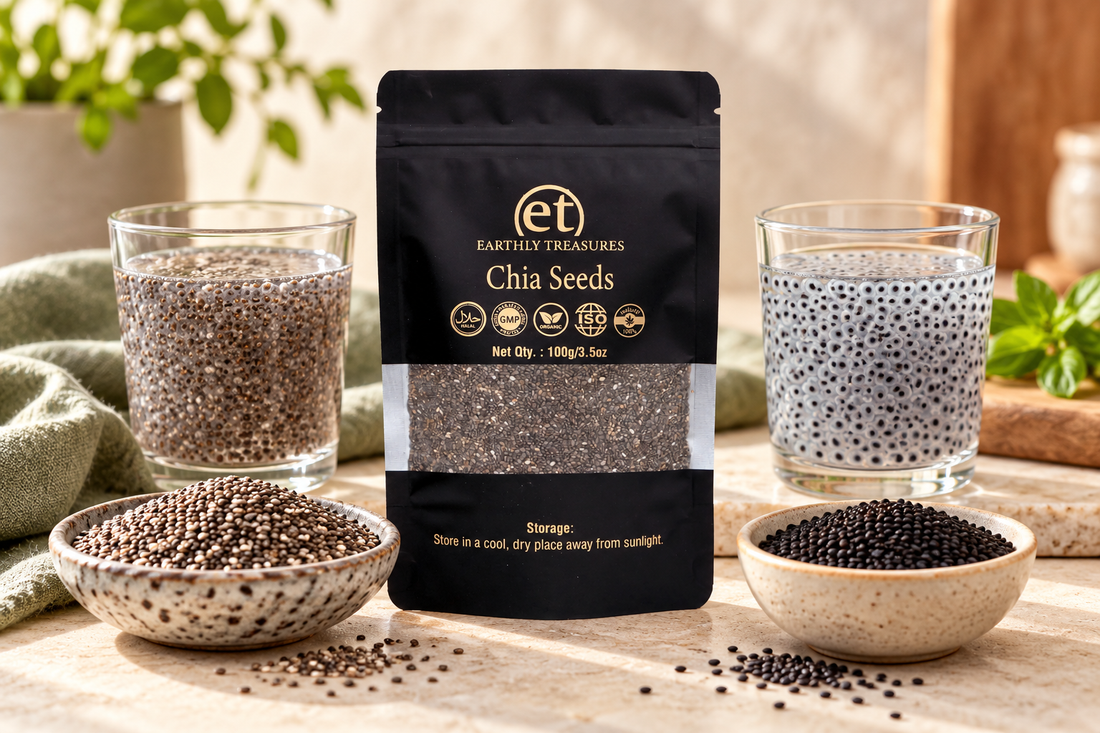
| Typical dry appearance | Small oval seeds, often mottled grey, black or white | Usually dark black seeds |
| In liquid | Develops a gel-like texture useful in pudding | Develops a translucent coating around the dark seed |
| Kitchen starting point | A recipe written for chia | A recipe written for edible basil seeds |
Appearance helps with a comparison, but photographs cannot authenticate an unknown packet. Kew’s botanical references recognise Salvia hispanica and Ocimum basilicum as distinct species. Its basil description also records the gel-forming edible seeds.
Which should you use for pudding?
Use chia when following our chia pudding recipe. The current Earthly Treasures directions use two tablespoons of chia with half a cup of milk, refrigerated until thick and evenly hydrated. Stir thoroughly at the start and again after settling begins to reduce clumps.
If you want to try basil seed pudding or a traditional drink, use food-grade edible basil seeds with their own directions. Do not copy the chia ratio and promise the same thickness or setting time. Water absorption, the surrounding ingredients and your preferred texture all affect the result.
Can you substitute one for the other?
A substitution is an experiment, particularly in recipes where seeds provide the structure. Try a small portion separately, follow the seed’s preparation instructions, and adjust liquid gradually. Do not replace the seeds in a full batch for guests before seeing how the texture changes.
Use seeds sold specifically for food. Gardening seeds may be treated and are not a substitute for a food packet. Hydrate according to the label before eating; do not swallow a spoonful of dry seeds as a shortcut.
Buying chia seeds in Pakistan
The current Earthly Treasures Chia Seeds listing describes 100% chia seeds in 100g individual packs. Check the selected quantity, preparation guidance and current pack before ordering. This comparison does not mean Earthly Treasures sells sabja seeds.
For a broader choice of preparation formats, read Mix Seeds in Pakistan. Keep dry packets separate and clearly labelled using the seed storage guide.
Frequently asked questions
Are chia and sabja the same plant?
No. Chia and sweet basil are distinct species. Verify a packet’s identity when local naming is unclear.
Which is better?
Choose for the recipe and texture you want. This kitchen comparison does not establish that one gives superior health results.
Do both need the same soaking time?
Do not assume so. Follow the specific product directions and check for even hydration before serving.